
Guides
How to build a maintenance plan a property management team will follow
How to build a property management maintenance plan: an asset register per building, triggers by component, a preventive calendar, and the owner sign-off.
What to take away
- A maintenance plan is a document per building, not a policy for the company. It lists what the building contains, when each item is looked at, who looks, and what the owner has agreed to fund.
- The plan is built in six steps, and the first step, the asset register, takes longer than the other five combined. Skipping it produces a calendar of guesses.
- Preventive work is scheduled by component and by trigger (season, age, prior failure), not by a generic monthly checklist copied from another building.
- The plan is signed by the owner, because the owner funds it, and revised after every emergency, because an emergency is a preventive task the plan missed.
Step one: the asset register
Walk the building with a clipboard or tablet and record every component that can fail and cost money. Equipment: heating and cooling, water heaters, plumbing risers and shutoffs, electrical panels, appliances by unit. Add laundry equipment and elevators where present.
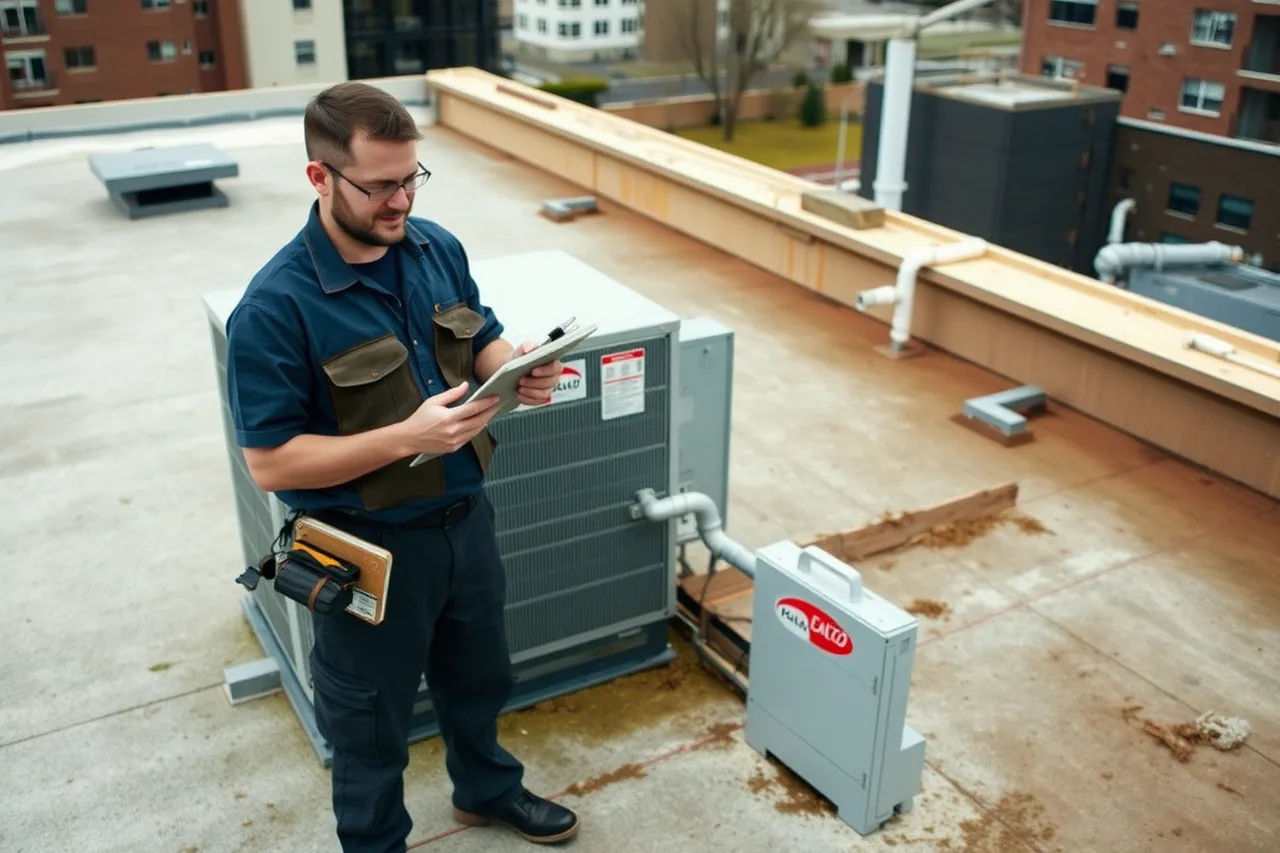
Envelope and grounds: roof and gutters, exterior envelope, windows and doors, pavement and drainage, landscaping irrigation. Safety and access: smoke and carbon monoxide detectors, fire extinguishers, common-area lighting, locks and access hardware.
For each item record the location, the make and model where there is one, the installation or last-replacement date if known, the condition on the day of the walk, and a photograph. Where the age is unknown, write "unknown" and note the visible condition; the register improves with each visit.
The register is the document the full repairs and maintenance system runs on. Deposit accounting at turnover relies on it too, since it fixes what was in the unit and its condition.
Step two: assign each component a trigger
A trigger is the event that puts a task on the calendar. Four kinds cover almost everything in a residential building:
Four trigger types
Seasonal
- What it means
- Done before a season
- Example task
- Heating before cold
- Source of timing
- Weather pattern
Interval
- What it means
- Fixed recurring cycle
- Example task
- Detector tests
- Source of timing
- Code or insurer
Condition
- What it means
- Set by last inspection
- Example task
- Worn roof inspection
- Source of timing
- Inspection finding
Turnover
- What it means
- Every vacancy
- Example task
- Lock re-keying
- Source of timing
- Unit vacancy
| Trigger type | What it means | Components it usually governs |
|---|---|---|
| Seasonal | The task is done before a season that stresses the component | Heating before cold weather, cooling before hot weather, gutters before the rainy season, irrigation before the first freeze |
| Interval | The task recurs on a fixed cycle set by the manufacturer, the code, or the insurer | Detector tests, extinguisher checks, water-heater flushing, dryer-vent cleaning, backflow tests where required |
| Condition | The task is triggered by what the last inspection found | A roof noted as "worn" gets a dry-season inspection; a panel noted as "warm" gets an electrician |
| Turnover | The task is done every time a unit is vacant | Detector replacement, caulking, filter change, lock re-keying, deep inspection of what a tenant's furniture hid |
The code-set intervals come from the local fire marshal, the housing or code office, and the state landlord-tenant statute. Record the source beside each interval rather than trusting a checklist from elsewhere.
Step three: build the calendar
Lay the triggered tasks on a twelve-month calendar for the building. Look for bunching: if every seasonal task lands in the same two weeks, the technician cannot do them and the emergency class fills up.
Building the twelve-month calendar
- Lay triggered tasks on a twelve-month calendar
- Check for bunching in the same two weeks
- Spread interval tasks evenly across months
- Reserve capacity for turnover clusters
- Assign each task to person or vendor
- Mark tasks needing a licensed trade
Spread interval tasks across the year so each month carries a similar load. Reserve capacity in the months when turnovers cluster.
Assign each task to a person or a vendor, and mark which tasks require a licensed trade. The hiring and training guide covers what the in-house technician can be trained to do; the contractor licensing board and the licensing and compliance guide cover what must be done by a licensee.
Step four: write the safety line into each task
A calendar task tells a person to touch equipment. OSHA's safety and health program guidance asks the employer to identify each task's hazard and pick the control.
Hazardous energy control sequence
- Shut off the energy source
- Lock the disconnect
- Verify zero energy state
- Then begin the work
For any task on a furnace, water heater, disposal, or panel that can energize while someone is inside it, the control of hazardous energy standard is the specific rule.
Write the control on the task card: shut off, lock, verify, then work. A calendar that schedules the task but not the control has scheduled the injury.
Step five: price it and get the owner's signature
Each task has an estimated cost: technician time, parts, and vendor fees. Total the year. Present it to the owner as a plan, with a number and a purpose against each line.
Owner sign-off package
- Estimated cost per tasktime, parts, vendor fees
- Total the year into one plan number
- Add last year's reactive repair spend
- Owner signs the plan or strikes lines
- Signed document shows what owner agreed to fund
- Post actual costs with work order and photograph
Add last year's reactive repair spend if the company has it. The owner signs the plan or strikes lines and signs what remains. Either way, the company holds a document showing what the owner agreed to fund, settling the argument when a struck line fails.
The plan's costs are posted as they occur, with the work order and photograph attached. The IRS guidance on what records a business should keep is the retention floor; the owner's accountant will usually want the register and the plan for the depreciation schedule.
Step six: revise after every emergency
Rule of the plan: every emergency-class work order is either a wrong interval or a missing component. There is no third category, and the plan is edited the same week either way.
Every emergency-class work order is read against the plan. Either the component was on the plan and the interval was wrong, or it was not on the plan at all. In both cases the plan changes, and the change is dated. A plan that has not changed in a year is a plan nobody reads.
Two templates, no numbers
Below are the two records that make the plan work. Copy the columns; fill in the building.
Asset register row: component, location, make and model, install or replacement date, condition at last inspection, photograph reference, trigger type, assigned person or vendor, licensed-trade flag, last done, next due.
Task card: building, component, task, trigger, safety control, person, estimated cost, owner-approved (yes or no, with date), actual cost, completion date, findings, next due.
No intervals, costs, or component lifetimes are stated on this page. The manufacturer's documentation, the local code, and the building's own history supply them, and any figure quoted here would be wrong for the reader's building.
When a plan is worth doing at all
A company with three buildings can hold this in a spreadsheet. A company expanding into a second territory needs it in software. The plan is what a new technician who has never seen the building inherits.
The expansion and market guide treats the maintenance plans of the acquired portfolio as the first thing to audit, since a portfolio without them is a portfolio of unknown liabilities.
Common questions
How long does the first asset register take?
Half a day for a small building, longer for anything with central systems. It is the cheapest half-day the company will spend on that building.
Should the owner see the full register?
Yes. The owner is funding the plan, and the register is what justifies each line. An owner who has never seen the register treats every preventive task as an upsell.
What if the owner strikes every line?
The company records that and continues to meet its legal obligations from the emergency and urgent classes, funded under the management agreement's authority. The struck plan is the company's evidence when a preventable failure arrives.
Does a maintenance plan replace inspections required by the city?
No. Code inspections are set by the local housing or code office and the fire marshal; the plan schedules the company's preparation for them and records the results, but the requirement is the city's.